You’ve probably seen that funny image of a monkey with its middle finger up. It looks like the monkey is flipping someone off, right? But is it really insulting someone?
Or is something else going on?
That’s the question I’m here to answer. monyet tunjuk jari tengah is a viral image, but it’s also a chance to explore some fascinating science. We’ll dive into the real reasons behind this gesture and separate the myths from the facts.
In the end, you might be surprised by what this reveals about both primate behavior and human perception.
Decoding Primate Communication: Is a Middle Finger an Insult?
First, let’s talk about the human context. The middle finger is a deeply ingrained cultural symbol of contempt with a long history.
Now, for non-human primates, communication is based on instinctual displays, not symbolic language.
Common primate threat or dominance displays include baring teeth, specific vocalizations, chest-pounding, or making themselves look larger.
These displays are very different from the abstract, learned nature of a human hand gesture. A monkey doesn’t have the cultural framework to understand its meaning.
So, from a primate’s perspective, a single extended digit has no inherent meaning and is not an intentional insult in the human sense.
Think about it this way: monyet tunjuk jari tengah wouldn’t mean anything to them. It’s like a dog wagging its tail. We assign the meaning ‘happy,’ but the biological function is more complex.
The Science of the Gesture: Coincidence, Anatomy, or Mimicry?
I once saw a monkey at the zoo make a gesture that looked like it was flipping us off. Everyone laughed, but it got me thinking. Why do monkeys sometimes make gestures that look so human?
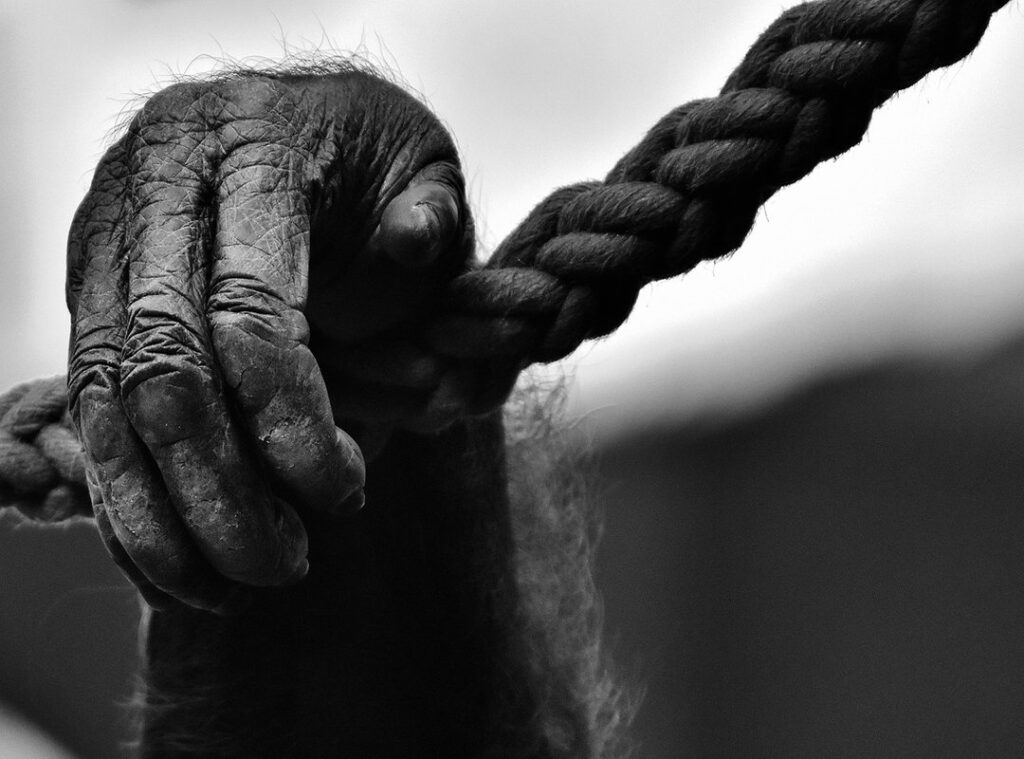
The most common scientific explanation is anatomical coincidence. Monkeys have five flexible digits for gripping, climbing, and grooming. One of those digits can easily become isolated by chance.
But there’s more to it than just anatomy. Our brains are wired to see familiar patterns in random arrangements. This is called pareidolia.
We see faces in clouds and hear voices in static. It’s no wonder we see a middle finger when a monkey moves its hand.
Learned behavior through mimicry is another theory. Primates, especially intelligent ones like capuchins and chimpanzees, are excellent mimics. A monkey in a zoo or tourist area might observe humans making the gesture and copy it without understanding its meaning.
Operant conditioning plays a role too. If a monkey accidentally makes the gesture and gets a strong reaction—like laughter, pointing, or even food—it learns to repeat the action to get the reward. This learned behavior is most common in primates with significant human interaction.
You rarely, if ever, see monyet tunjuk jari tengah in the wild. Pblgamevent
So, the next time you see a monkey making a rude gesture, remember it’s probably just a mix of anatomy, mimicry, and a bit of learned behavior.
Viral Moments: When Monkeys Became Internet Famous
You’ve probably seen those viral photos or videos where a monkey seems to be making a funny gesture. One famous example is the Japanese macaque in the snow, looking like it’s smiling. Another is the monyet tunjuk jari tengah video, which went viral for its apparent cheeky behavior.
The context of these moments is often lost in the framing. The macaque, for instance, was just balancing in the cold, not posing for a photo. The video clip might show a split second of a gesture, but the full video could reveal something entirely different.
This kind of content taps into our love for anthropomorphism—assigning human traits to animals. It’s why we find it so amusing and shareable. We see the monkey as if it’s human, with the same intentions and emotions.
But here’s the thing. While the images are real, the intention we assign to them is all in our heads. The monkey isn’t actually trying to be funny or cheeky; it’s just being a monkey.
So, how should you view such content? Look for the full video or surrounding photos. This will give you a better understanding of the animal’s actual behavior.
It’s a good practice to critically view what you see online.
What This Says About Us

Why are we so fascinated by the idea of a monyet tunjuk jari tengah? It’s because attributing human emotions and intentions to animals helps us feel more connected to them.
We see a bit of ourselves in their actions, even if it’s just our imagination at work. But there’s a fine line between harmless fun and misinterpreting animal welfare. A gesture we find funny might be part of an animal’s stress response.
Understanding their true behavior is a more profound way to appreciate animals than forcing our own narratives onto them. Our fascination highlights a desire to find human-like intelligence and personality in the natural world.
Respect wildlife, and don’t provoke animals for a photo opportunity. Instead, observe and learn from them.
That’s the real connection we should be aiming for.
The Real Story Behind the Monkey’s Gesture
The gesture is almost always a combination of coincidence, learned mimicry, or our own human interpretation. It’s important to understand that the monkey is not being intentionally rude; it lacks the cultural context to understand the gesture’s meaning.
monyet tunjuk jari tengah might seem like a deliberate act, but it’s more likely a reflection of our own human culture. Next time you see a ‘rude’ monkey, consider shifting your perspective.
Ask yourself: What is this animal’s natural behavior and why am I interpreting it this way?

 Michael Dealianores writes the kind of gaming news and updates content that people actually send to each other. Not because it's flashy or controversial, but because it's the sort of thing where you read it and immediately think of three people who need to see it. Michael has a talent for identifying the questions that a lot of people have but haven't quite figured out how to articulate yet — and then answering them properly.
They covers a lot of ground: Gaming News and Updates, Upcoming Game Releases, Expert Commentary, and plenty of adjacent territory that doesn't always get treated with the same seriousness. The consistency across all of it is a certain kind of respect for the reader. Michael doesn't assume people are stupid, and they doesn't assume they know everything either. They writes for someone who is genuinely trying to figure something out — because that's usually who's actually reading. That assumption shapes everything from how they structures an explanation to how much background they includes before getting to the point.
Beyond the practical stuff, there's something in Michael's writing that reflects a real investment in the subject — not performed enthusiasm, but the kind of sustained interest that produces insight over time. They has been paying attention to gaming news and updates long enough that they notices things a more casual observer would miss. That depth shows up in the work in ways that are hard to fake.
Michael Dealianores writes the kind of gaming news and updates content that people actually send to each other. Not because it's flashy or controversial, but because it's the sort of thing where you read it and immediately think of three people who need to see it. Michael has a talent for identifying the questions that a lot of people have but haven't quite figured out how to articulate yet — and then answering them properly.
They covers a lot of ground: Gaming News and Updates, Upcoming Game Releases, Expert Commentary, and plenty of adjacent territory that doesn't always get treated with the same seriousness. The consistency across all of it is a certain kind of respect for the reader. Michael doesn't assume people are stupid, and they doesn't assume they know everything either. They writes for someone who is genuinely trying to figure something out — because that's usually who's actually reading. That assumption shapes everything from how they structures an explanation to how much background they includes before getting to the point.
Beyond the practical stuff, there's something in Michael's writing that reflects a real investment in the subject — not performed enthusiasm, but the kind of sustained interest that produces insight over time. They has been paying attention to gaming news and updates long enough that they notices things a more casual observer would miss. That depth shows up in the work in ways that are hard to fake.